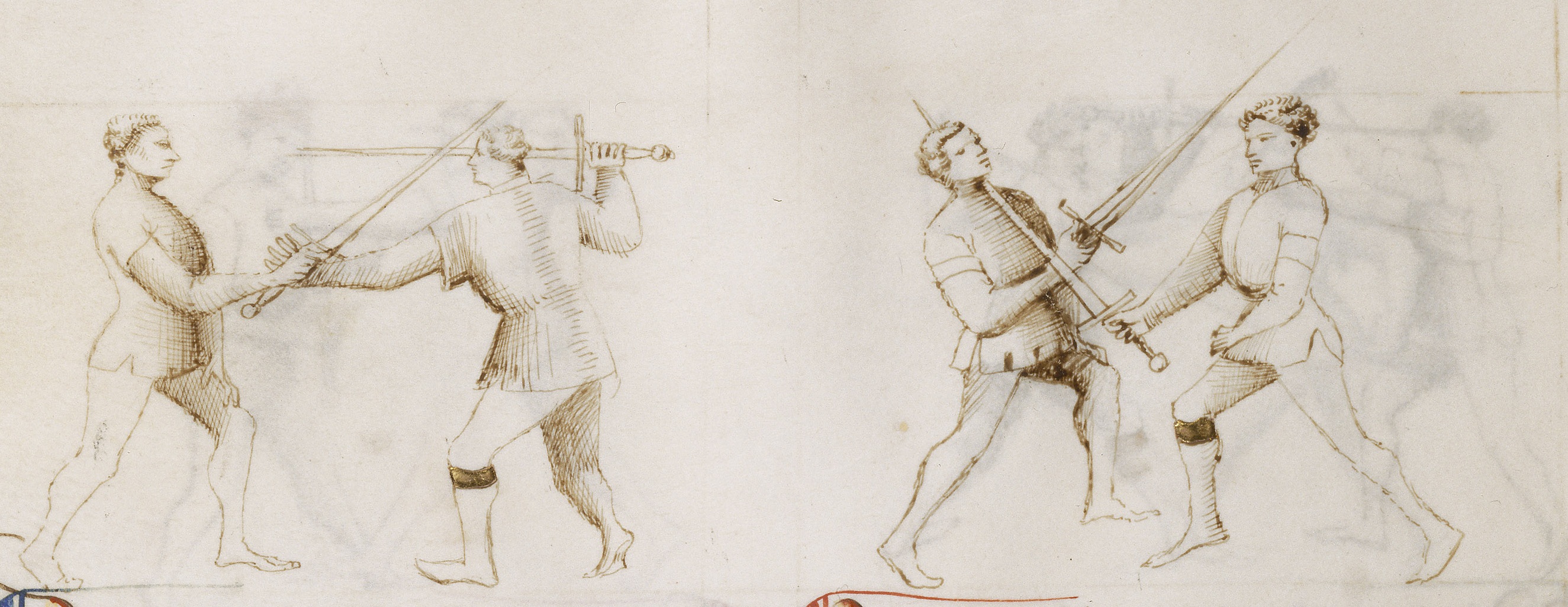
So, there was big discussion a few months ago on how to cut with a long sword.
Lots of words were said by a great many voices.
The gist of it was: Push-Pull Cutting model: good or bad?
The response I took away from the forums was that many people were not into it. They (the bulk of the forum people) preferred a Core Rotation Centered Model. I found that interesting.
Now, I teach a PPC model.
Slow Down Tiger. I never said the other model was wrong. Indeed, many strong sword arts rely on it. And yes, it cuts soft targets better. and the tip of the sword may be moving slightly faster. etc.
So why do I use the bad one? Well, in the context of 14th century fighting, with a 14th century sword (Oakshotte type XVa), it is the better way fighting. Big words you say? Maybe, but keep reading and I will back it up.
My actions in any fight need to be be purpose driven.
Those actions should be Mechanically efficient, and those mechanics must serve to drive all follow up actions.
The Old Man (Fiore) has some express advice on cutting for us, such as his art and his targeting suggestions. He is aiming to clip the neck, and thrust into unarmored parts, keeping the hand fairly low, projecting the weapon down or forward towrads the target.
OK, so, lets also look at the sword itself: a type XVa Long Sword.
40-50 inches long, 3-4 lbs in mass (101.6 -127 cm, 1.3-1.8 kg) on average, for antique pieces.
Very acute blade profile. fine point, large overall mass. Hmm. Popular during the hundred years war and warring Italy. A solid side arm for fighting against armor, and certainly sharp enough to do some real harm to those unlucky enough to not bear any armor.
While it does not have the cutting potential of its wider bladed cousins, what it does do rather well is chop. It chops into things, and then slices free as part of the recovery phase of the motion.
The chopping motion creates a jarring impact, and does so quickly. The forward traveling momentum means that any contact will work towards driving back an incoming action, leading to a strong over bind. Any wound created should be more than adequate to disable the target as well.
That brings us back to purpose.
The goal of my fight is to end the conflict with out being struck, or failing that, to survive.
Things that I need to do to make that happen:
- Put my edge to them, before they cut me.
- Close lines
- Offer sufficient impact to clear swords, lances, and wound my opponent.
Attacking on a wider line than show will leave lines un-closed as I enter. and cost me travel time, as well as set up less strong binds, should my opponent defend it.
In short, I feel this model is faster, equally accurate, and more effective tactically. I don't need more shearing power for the fight, the recovery offers more than enough.
I'll save my bigger cuts for the grass mats.
PS,
on the topic of purpose, every fight ends with a thrust, so part of my purpose in making a blow is to set that up. helps to guarantee the other person stays down.
I am one who longs to refine the fight, to know the art.
It is my struggle to better understand it, to refine my skill and my mind to embrace the art better, but this struggle, like the art itself, is not mine alone.
-
It should not be mine alone, in that there are many who would become pillars of the art, in its many forms. Their claims are as solid as my own, and without them to challenge, the art cannot grow.
-
It cannot be mine alone, in that no one of us can bear the entirety of it in their waking mind. There will be books and other tools of learning to hold the lore, for our memories are soft and malleable. There must be other minds to think it, or it will grow stale.
-
It will not be mine alone. I am mortal, and to dust I will return. The art must live beyond the borders of my time in the coil. As such, it is my responsibility to not train alone. To build. To sustain.
To this end I speak of those that will follow me. Those who will bear the art forward, those who learn it now for the first time, and begin their own journeys.
I was first paid to teach others what I know of the sword in 2001. At that time, I lit my torch from one held out by another. I have sought to use that flame to light that fire in others. Flame itself cannot be destroyed, only exhausted or extinguished. It is my hope that once a torch is lit, it will carry the art long enough to light the next. In this way, we keep the memory of the past well lit.
This weekend, I had the immense pleasure of raising four of my young students to the rank of Cavalier, the senior most rank in our youth program. They have spent years learning to use the sword, to wrestle, and the virtues of chivalry. They have written out how they would live these virtues, and shown me their drive, intelligence, and cleverness in many ways. Telling me stories of the past, learning to cook, and teaching me things about the art I would never have seen without the lens of their questions.
They proved with sweat and bruises that they can, and will, use the art. To teach each other and grow their skills together. They won the approval of their fellow students with effort and conduct that was above the bar I had set for them.
I cannot know what they will do with what I have given them, but these young people have given me a greater gift than they have received - they have grown strong, both in themselves and through their friendships to each other. They have shown me that strength and compassion will go forward, and that is why the art exists.
Most of all they have taught me that I am not seeking to pass the torch, in some fatalistic gesture, but that my real task is to light as many as can be lit, and in that they show me a brighter world.
To my students in the Cavalier Youth Program,
Thank you.
So, when learning the sword, We need to learn a few important skills to make all the fancy plays work for us.
One of those skills is control of space. There are many aspects of that, and one of the first of those is learning to appreciate the distance your sword can reach. If you don't know your own measure you will certainly not be able to understand the measure of other people's reach.
One fun way I teach this is through paper cutting.
It lets you not only work on understanding your own measure, it gives a student the feeling of cutting through a target. I have strong feelings that understanding the feeling of a cut is vital to understanding the more subtle nuances of blade handling.
So, the drill works like this:
Suspend a bit of paper from a rod or pole making sure it is reasonably well attached.
Test your measure with a single step, making sure to just barely brush the surface of the paper with the sword. By the way, Rawlings type nylons are much more suitable than the Pentii types for this particular purpose.
Step back, and take a quick cut at the paper, again being sure to just brush the paper with the tip of the sword, but this time the speed of the sword will be enough to slice through the paper. The cleaner the cut, the better your measure control was.
This is a very good way for new students to work on their measure, and to prepare them for cutting with sharp swords down the line.
So, for some time the CSG has been using this little ditty to introduce new swords-folk to the basics of Fiore. It has all the goodies: passing and gathering footwork, as well as a volta stabile and a mezza volta.
It also covers our first 4 partnered exercises.
That's the little bit I will speak on today. It's useful and important to have you drills match your practice. I acknowledge that it can be of befit to have some basic dexterity drills, and such, worked into your basic solo-practice habits.
Still, I think the at early phases of training, ingraining the plays you want to have occur in your sword fight now, right at he beginning, is vital to executing those plays. The students in this demo ore some of our younger fighters, just getting ready to enter the pain program, yet they have these drills down. I start the children off on the same main drill as our adults.
So, what does your introductory cutting drill look like? I hope for links in the comments.
Playing the prize is an old tradition. My participation in it however, is not. Gaining ranks in the CSG
is typically accompanied by a your peers and betters challenging the right to go forward. This is to ensure that standards are maintained, and as a right passage.
Posted here is a video of my most recent deed of arms, and more particularly my holding of the field.
I am Soliciting feedback. I want your thoughts on how it went, and how I could improve. This is a public event, and as such, I'd like you feed back delivered though this channel. So the floor is open. Hit me with your best shot.
SPOILERS - Please do not read beyond here until you have watched the vid. below is my own take and intentions.
OK? you watched the video? Ok then, carry on.
For my own feed back, excepting my fight with Shannon, I made my best efforts to hold the fight at weapons range. I did not wear a dagger, as further encouragement. This went....ok. It was hard to keep folks from crashing in.
It also showed me that while I was in decent shape for this fight, helmets with more holes for breathing are very helpful. I feel like a gassed out a lot. I was really feeling it by the end.
I also noticed that in full arms and legs, it is rather hard to feel. this was the first time i had worn this much armor, and i loved it, but i noticed I was much less sensitive.
There are two kinds of Abrazare - one done for sport, and one done in anger or defending one's life.
This is kind I will talk about. ~ Fiore
One of the things I truly love about The Flower of Battle is that is repeats itself. Fiore was a simple guy, it would seem. every section starts off with an inside bind, usually with the left leg front, and the descends from there into various plays and remedies.
Now, Many will agree that many of the old man's plays arise from various specific crossings of the sword. Do we agree that he sets up his book in this way? But why then does he only give us one such crossing in the Abrazare section?
I posit - he actually gives us a great many. To paraphrase a bit, use the binds that arise from that arise from abrazare, and strike you foe in the places most dangerous or painful.
Those two lines from the prologue give us permission to come to grips from a place of striking. "Coming to grips" is how I interpret the variety of binds that may exist. We grabbed each other. There are a whole lot of sensible ways to grab some one who is trying to hurt you. You could clinch the head, tackle the body, upend the legs, or put the belt on 'em. Which only names a few "Crossings".
To strike with the hands makes a good deal of sense in a wide variety of situations. Whether we are faced with a common tough, looking to liberate coin from our person, or a fellow warrior on the field of battle, sluggin' the assailant in the kisser or taking their nethers on a boot ride to heaven seem like great ways to distract them or soften them up for further action.
So, it's there for us.
There are a great many ways for us to come to grips, and so many crossings of the arms that may occur that it made my head spin just considering them, till I noticed that most of them don't matter. A lot of them are so fleeting that there is no way to meaningfully use the moment. hand to had strikes rarely elicit "binds" of useful duration.
Silver talks about this when he notes the dagger is too short to make a crossing. Punches don't make for the best crossings either, no lasting binds will occur here.
So which crossings DO matter? Well, I can't say for sure, but I have settled on three of them to work with in training. They cover a pretty good spread of situations in stand up hand to hand combat. The clinch, the Classic underhook, and the peasant throw. Now, Fiore does not draw us a clinch in his pictures. But it comes up in life too much to ignore it. So I will use "Fioreish stuff" to address the problem.
So, some basics.
How do we hit them? - Hard.
We need to be able to hit hard. Bang, I like to call it. One must deliver enough juice for the target to care. So, in video chunk one, we'll look at using the hips to generate that "bang". Get your minds out of the gutter. I am talking about face punching. We need to deliver crisp, sharp blows that elicit a strong response. And by response I mean their body should displace under the impact.
Where do we hit them? - Where it hurts.
We need to know where to put biscuit in order to fill up that basket. The jaw, neck, mouth, floating ribs, kidneys and groin are what Fiore suggests. But in a pinch, any target will do. What I mean to say is, when in doubt, Gob them one good.
Follow up. - It ain't over till they taste dust.
If one is good, two is better. The main point of these strikes is to set up what comes next. to you had best be ready to break or throw your opponent after you hit'em.This is really the most important part of Abrazare. The ability to take advantage of the hits you deliver to finish the fight. As always, I define that as being the human that ends in control of the conflict. Fiore made a point that in his duels he came away with out injury, not that he murdered 5 people. My mission is the same - survive with out harm to me.
That means controlling the target, and being ready to deal with the targets buddies.
So, here is the video -
It will go over a few types of strike,
power generation on the high line,
a simple training drill to come to a bind,
and using Firere to break a grab.
I'd love to see YOUR version of the drill, which bind you might break.
post them in he comments. I'll take text versions as well.
Any way - Were gonna deal with the clinch.
So, the above pictures will appear in my video, the one on the left is what I use to justify Fiore dealing with a clinch type grab. Clearly the dude has been grabbed by the head. In the first frame, the defender is using a strike to the eyes to break the offenders grip. the second is not an immediate follow on in the book, but Fiore recommends you break his chestnuts in two when held in that manner.
Lets link this together, along with a plausible crossing.
1. Offender decides its time to hit the Defender - and he goes for it.
2. Defender clears and hits back - "winning"
3. Offender gets in and grabs the defender to stop the face punches
4. Defender breaks the clinch and regains control.