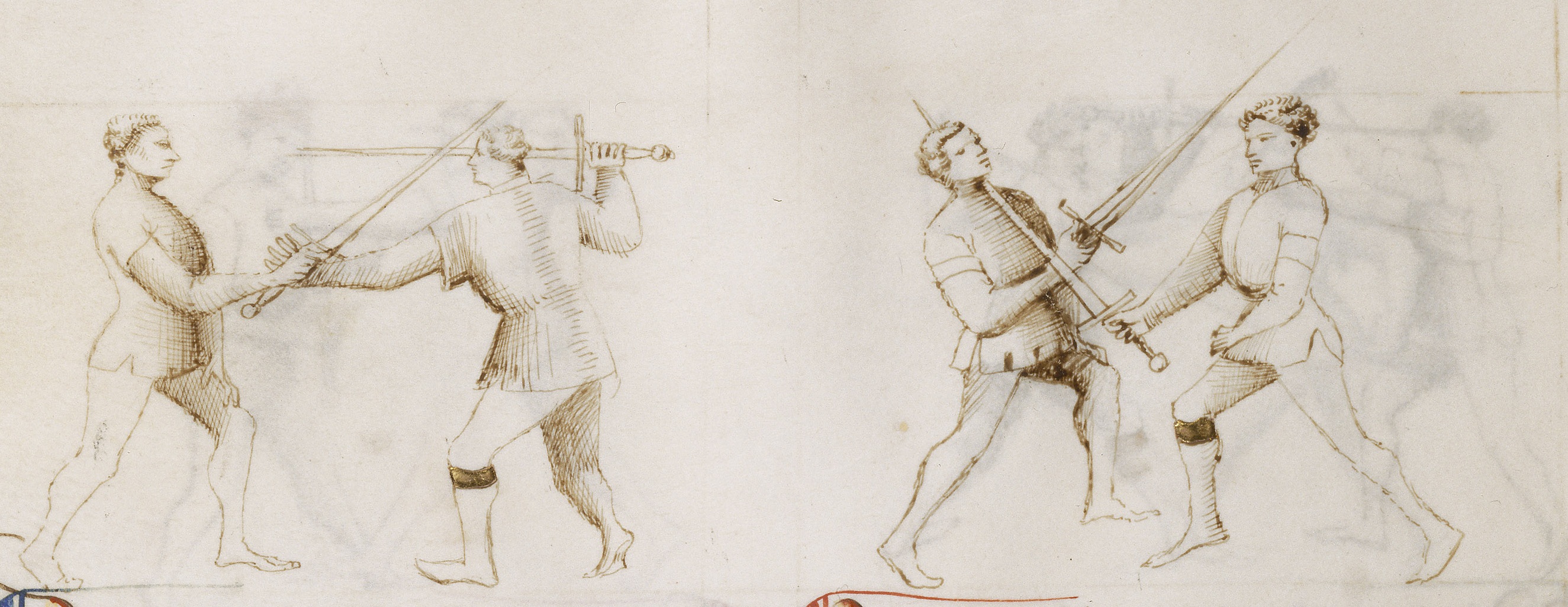
Been some discussion of the 1st remedy of dagger on the IAS forum.
So, the CSG version, or I suppose, our take on the action.
Against a downright forehand blow of the dagger (Mandrito Fendente), move forward, into the attack, Lifting the left arm to thrust over the opponents right arm. you should end left arm and left foot forward, arm above the opponent's.
This should blow the opponents weapon back the way it came, negating the forward momentum or the blow.
So, there was big discussion a few months ago on how to cut with a long sword.
Lots of words were said by a great many voices.
The gist of it was: Push-Pull Cutting model: good or bad?
The response I took away from the forums was that many people were not into it. They (the bulk of the forum people) preferred a Core Rotation Centered Model. I found that interesting.
Now, I teach a PPC model.
Slow Down Tiger. I never said the other model was wrong. Indeed, many strong sword arts rely on it. And yes, it cuts soft targets better. and the tip of the sword may be moving slightly faster. etc.
So why do I use the bad one? Well, in the context of 14th century fighting, with a 14th century sword (Oakshotte type XVa), it is the better way fighting. Big words you say? Maybe, but keep reading and I will back it up.
My actions in any fight need to be be purpose driven.
Those actions should be Mechanically efficient, and those mechanics must serve to drive all follow up actions.
The Old Man (Fiore) has some express advice on cutting for us, such as his art and his targeting suggestions. He is aiming to clip the neck, and thrust into unarmored parts, keeping the hand fairly low, projecting the weapon down or forward towrads the target.
OK, so, lets also look at the sword itself: a type XVa Long Sword.
40-50 inches long, 3-4 lbs in mass (101.6 -127 cm, 1.3-1.8 kg) on average, for antique pieces.
Very acute blade profile. fine point, large overall mass. Hmm. Popular during the hundred years war and warring Italy. A solid side arm for fighting against armor, and certainly sharp enough to do some real harm to those unlucky enough to not bear any armor.
While it does not have the cutting potential of its wider bladed cousins, what it does do rather well is chop. It chops into things, and then slices free as part of the recovery phase of the motion.
The chopping motion creates a jarring impact, and does so quickly. The forward traveling momentum means that any contact will work towards driving back an incoming action, leading to a strong over bind. Any wound created should be more than adequate to disable the target as well.
That brings us back to purpose.
The goal of my fight is to end the conflict with out being struck, or failing that, to survive.
Things that I need to do to make that happen:
- Put my edge to them, before they cut me.
- Close lines
- Offer sufficient impact to clear swords, lances, and wound my opponent.
Attacking on a wider line than show will leave lines un-closed as I enter. and cost me travel time, as well as set up less strong binds, should my opponent defend it.
In short, I feel this model is faster, equally accurate, and more effective tactically. I don't need more shearing power for the fight, the recovery offers more than enough.
I'll save my bigger cuts for the grass mats.
PS,
on the topic of purpose, every fight ends with a thrust, so part of my purpose in making a blow is to set that up. helps to guarantee the other person stays down.
I am one who longs to refine the fight, to know the art.
It is my struggle to better understand it, to refine my skill and my mind to embrace the art better, but this struggle, like the art itself, is not mine alone.
-
It should not be mine alone, in that there are many who would become pillars of the art, in its many forms. Their claims are as solid as my own, and without them to challenge, the art cannot grow.
-
It cannot be mine alone, in that no one of us can bear the entirety of it in their waking mind. There will be books and other tools of learning to hold the lore, for our memories are soft and malleable. There must be other minds to think it, or it will grow stale.
-
It will not be mine alone. I am mortal, and to dust I will return. The art must live beyond the borders of my time in the coil. As such, it is my responsibility to not train alone. To build. To sustain.
To this end I speak of those that will follow me. Those who will bear the art forward, those who learn it now for the first time, and begin their own journeys.
I was first paid to teach others what I know of the sword in 2001. At that time, I lit my torch from one held out by another. I have sought to use that flame to light that fire in others. Flame itself cannot be destroyed, only exhausted or extinguished. It is my hope that once a torch is lit, it will carry the art long enough to light the next. In this way, we keep the memory of the past well lit.
This weekend, I had the immense pleasure of raising four of my young students to the rank of Cavalier, the senior most rank in our youth program. They have spent years learning to use the sword, to wrestle, and the virtues of chivalry. They have written out how they would live these virtues, and shown me their drive, intelligence, and cleverness in many ways. Telling me stories of the past, learning to cook, and teaching me things about the art I would never have seen without the lens of their questions.
They proved with sweat and bruises that they can, and will, use the art. To teach each other and grow their skills together. They won the approval of their fellow students with effort and conduct that was above the bar I had set for them.
I cannot know what they will do with what I have given them, but these young people have given me a greater gift than they have received - they have grown strong, both in themselves and through their friendships to each other. They have shown me that strength and compassion will go forward, and that is why the art exists.
Most of all they have taught me that I am not seeking to pass the torch, in some fatalistic gesture, but that my real task is to light as many as can be lit, and in that they show me a brighter world.
To my students in the Cavalier Youth Program,
Thank you.
So, when learning the sword, We need to learn a few important skills to make all the fancy plays work for us.
One of those skills is control of space. There are many aspects of that, and one of the first of those is learning to appreciate the distance your sword can reach. If you don't know your own measure you will certainly not be able to understand the measure of other people's reach.
One fun way I teach this is through paper cutting.
It lets you not only work on understanding your own measure, it gives a student the feeling of cutting through a target. I have strong feelings that understanding the feeling of a cut is vital to understanding the more subtle nuances of blade handling.
So, the drill works like this:
Suspend a bit of paper from a rod or pole making sure it is reasonably well attached.
Test your measure with a single step, making sure to just barely brush the surface of the paper with the sword. By the way, Rawlings type nylons are much more suitable than the Pentii types for this particular purpose.
Step back, and take a quick cut at the paper, again being sure to just brush the paper with the tip of the sword, but this time the speed of the sword will be enough to slice through the paper. The cleaner the cut, the better your measure control was.
This is a very good way for new students to work on their measure, and to prepare them for cutting with sharp swords down the line.
So, for some time the CSG has been using this little ditty to introduce new swords-folk to the basics of Fiore. It has all the goodies: passing and gathering footwork, as well as a volta stabile and a mezza volta.
It also covers our first 4 partnered exercises.
That's the little bit I will speak on today. It's useful and important to have you drills match your practice. I acknowledge that it can be of befit to have some basic dexterity drills, and such, worked into your basic solo-practice habits.
Still, I think the at early phases of training, ingraining the plays you want to have occur in your sword fight now, right at he beginning, is vital to executing those plays. The students in this demo ore some of our younger fighters, just getting ready to enter the pain program, yet they have these drills down. I start the children off on the same main drill as our adults.
So, what does your introductory cutting drill look like? I hope for links in the comments.
Playing the prize is an old tradition. My participation in it however, is not. Gaining ranks in the CSG
is typically accompanied by a your peers and betters challenging the right to go forward. This is to ensure that standards are maintained, and as a right passage.
Posted here is a video of my most recent deed of arms, and more particularly my holding of the field.
I am Soliciting feedback. I want your thoughts on how it went, and how I could improve. This is a public event, and as such, I'd like you feed back delivered though this channel. So the floor is open. Hit me with your best shot.
SPOILERS - Please do not read beyond here until you have watched the vid. below is my own take and intentions.
OK? you watched the video? Ok then, carry on.
For my own feed back, excepting my fight with Shannon, I made my best efforts to hold the fight at weapons range. I did not wear a dagger, as further encouragement. This went....ok. It was hard to keep folks from crashing in.
It also showed me that while I was in decent shape for this fight, helmets with more holes for breathing are very helpful. I feel like a gassed out a lot. I was really feeling it by the end.
I also noticed that in full arms and legs, it is rather hard to feel. this was the first time i had worn this much armor, and i loved it, but i noticed I was much less sensitive.
There are two kinds of Abrazare - one done for sport, and one done in anger or defending one's life.
This is kind I will talk about. ~ Fiore
One of the things I truly love about The Flower of Battle is that is repeats itself. Fiore was a simple guy, it would seem. every section starts off with an inside bind, usually with the left leg front, and the descends from there into various plays and remedies.
Now, Many will agree that many of the old man's plays arise from various specific crossings of the sword. Do we agree that he sets up his book in this way? But why then does he only give us one such crossing in the Abrazare section?
I posit - he actually gives us a great many. To paraphrase a bit, use the binds that arise from that arise from abrazare, and strike you foe in the places most dangerous or painful.
Those two lines from the prologue give us permission to come to grips from a place of striking. "Coming to grips" is how I interpret the variety of binds that may exist. We grabbed each other. There are a whole lot of sensible ways to grab some one who is trying to hurt you. You could clinch the head, tackle the body, upend the legs, or put the belt on 'em. Which only names a few "Crossings".
To strike with the hands makes a good deal of sense in a wide variety of situations. Whether we are faced with a common tough, looking to liberate coin from our person, or a fellow warrior on the field of battle, sluggin' the assailant in the kisser or taking their nethers on a boot ride to heaven seem like great ways to distract them or soften them up for further action.
So, it's there for us.
There are a great many ways for us to come to grips, and so many crossings of the arms that may occur that it made my head spin just considering them, till I noticed that most of them don't matter. A lot of them are so fleeting that there is no way to meaningfully use the moment. hand to had strikes rarely elicit "binds" of useful duration.
Silver talks about this when he notes the dagger is too short to make a crossing. Punches don't make for the best crossings either, no lasting binds will occur here.
So which crossings DO matter? Well, I can't say for sure, but I have settled on three of them to work with in training. They cover a pretty good spread of situations in stand up hand to hand combat. The clinch, the Classic underhook, and the peasant throw. Now, Fiore does not draw us a clinch in his pictures. But it comes up in life too much to ignore it. So I will use "Fioreish stuff" to address the problem.
So, some basics.
How do we hit them? - Hard.
We need to be able to hit hard. Bang, I like to call it. One must deliver enough juice for the target to care. So, in video chunk one, we'll look at using the hips to generate that "bang". Get your minds out of the gutter. I am talking about face punching. We need to deliver crisp, sharp blows that elicit a strong response. And by response I mean their body should displace under the impact.
Where do we hit them? - Where it hurts.
We need to know where to put biscuit in order to fill up that basket. The jaw, neck, mouth, floating ribs, kidneys and groin are what Fiore suggests. But in a pinch, any target will do. What I mean to say is, when in doubt, Gob them one good.
Follow up. - It ain't over till they taste dust.
If one is good, two is better. The main point of these strikes is to set up what comes next. to you had best be ready to break or throw your opponent after you hit'em.This is really the most important part of Abrazare. The ability to take advantage of the hits you deliver to finish the fight. As always, I define that as being the human that ends in control of the conflict. Fiore made a point that in his duels he came away with out injury, not that he murdered 5 people. My mission is the same - survive with out harm to me.
That means controlling the target, and being ready to deal with the targets buddies.
So, here is the video -
It will go over a few types of strike,
power generation on the high line,
a simple training drill to come to a bind,
and using Firere to break a grab.
I'd love to see YOUR version of the drill, which bind you might break.
post them in he comments. I'll take text versions as well.
Any way - Were gonna deal with the clinch.
So, the above pictures will appear in my video, the one on the left is what I use to justify Fiore dealing with a clinch type grab. Clearly the dude has been grabbed by the head. In the first frame, the defender is using a strike to the eyes to break the offenders grip. the second is not an immediate follow on in the book, but Fiore recommends you break his chestnuts in two when held in that manner.
Lets link this together, along with a plausible crossing.
1. Offender decides its time to hit the Defender - and he goes for it.
2. Defender clears and hits back - "winning"
3. Offender gets in and grabs the defender to stop the face punches
4. Defender breaks the clinch and regains control.
Teaching children has been rewarding a humbling. These last three years have taught me a great deal about myself, as well as my fellow man.
There is little else I can say about it. These kids, the challenge what I know of the art, and force me to refine and simplify it at the same time, in order to convey what they must learn to take over as the next generation.
The force me to iterate the information, scaling it up as they mature and are able to handle increasingly complex tasks and store more data.
They force me to articulate the Virtues of a martial artist, and what these virtues mean to them in their lives. To teach them to be gentle hunters in a world that could just as easily render them hard and uncaring. To show them how to be firm, while being open to new people and ideas, with out losing the path.
I will never be able to thank them enough for the experience, the lessons they have taught me. It is my express hope that what I give to them measures up to the potential they show, and that I do not let them down as they grow older.
Always, it has been my job to replace myself when the day comes that I can no longer bear up the sword. While I am yet young, and that day is in the distance, these kids give me hope that there WILL be some one there to pick up the torch, and bear it forward. That is their gift to me.
So, in the wide world of sword fighting, there are many modes of training.
Now, I don't me get me wrong here: some schools are lazy and some schools train hard - But that's not at all what we are chatting about today
What I mean is that there are different modes of training to bring out different skills and actions from our students.
These two modes of training fall into two primary branches. Development and Simulation. (Now I want to point out that I get these classifications from Mike VanBeek, my Self defense coach. While not a fencer, the guy is right as rain and credit goes where it is due.)
Any way, Simulation includes things like Sparring, Semi-competitive drills like Set-plays (step-sparring) and other resisted or competitive drills. These drills give us a taste of what we are training to defeat, and help us work on our will, and temper our skills in the fire of resistance.
Developmental drills are things like Flow drills, Kata (for lack of a better word) and other consensual drills that work of skill or attribute development in a non competitive environment, so that a student can work on mechanics and or isolate issues so that one can take not of each rep and sharpen the knife, so to speak.
You need both to develop a complete martial artist. It is important to note here that the two drills types are related, and can flow into one another. The intensity levels can vary wildly as well.Simulation can be dialed down, and development can reach levels that feel as though they are Fight Simulations.
Today I will talk a little bit about developmental drills.
Developing movement, comfort, and confidence are a vital part to building true skill. These types of drills break down the elements of any given technical set, and let people isolate the components. Students new and old can benefit from this, ans we use this to hone our understanding of the underlying principles that let these actions work for us in the fight. Rushing into simulation too soon (or not soon enough, though that's for a later chat) can lead to ingraining of bad habits and weak mechanics. Weak mechanics, as one man said, means that while you may get good fast, but you will never be great.
I am not willing to accept such a limit.
On to our example.
In our school, we teach 2 primary types a throw to novice and intermediate students. A rear leg type take down, and what we call a collar throw, or Ballestrata in Italian. we use a number of tools to teach this.
This video will go over a few days worth of classroom footage, all focusing on developing a students ability to use these throws in sparring and possibly self defense.
This development will go through a few phases.
1. Looking at a little bit of context on what leads to wrestling-distance in a "fight".
2. Getting comfortable in that close range.
3. Learning the mechanics of the throws in question,
4. Learning to find the moment when these throws can be applied.
This 4th phase will have the added benefit of also quietly slipping the basics on countering these throws into the students brains. I Like this "back road" approach, as lessons that people reach on their own often stick with the students and help keep them thinking about the fight on their own. a student with questions is better than a student who follows dogma.
So, In the video, I take the students from the basics of unarmed range closure, add throws, and along the way work to improve their movement skills and comfort and manipulating others, as well as being manhandled.
The Next Phase for this would be simulation, which we will cover in the next blog.
It comes up in Fiore's manuscripts several times - the old man likes to break arms.
Since he says that he has done these things, and that they are reliable, Lets take that grain of salt and take a hard look at them.
Now, in modern terms, knife fights are ugly, nasty things in which the opponent usually comes at us hard, fast, and from concealment and surprise. Stopping the knife is of course rather high priority.
So how do we do this and then set up one of the old man's fancy arm brakes when the other guy is resisting you?
Step one: Stop the knife with Prejudice. My working concept is that all strikes are parries and every parry is a strike. It is vital that you abate the pressure of your foe's attack. do that by hurting said foe.
Step two: Reverse the flow of pressure. You were being attacked. Now YOU are the attacker. The video will show this better, but use what ever tools are needed. Punch, Kick, Go get'em. Scare'em
Step three: Go for it. this kind of action does not brook hesitation. grab that arm, and get under it before your subject see what line you are attacking. It the enemy thinks you are going for some kind of akido attack, this is good, as you want them to try to recover the arm from you. this only helps you move t behind them.
Step four: In training, there is no step four. Fiore says train with compassion. If you are doing so, then we're done here. To pull the arm all the way down and brake it would be to add Malice, which we must reserve for battle.
For some time now, There has been a strong division between swords people: Do George Silver's true times apply to all swordsmanship, or just his? Well, I welcome your opinions, but my answer is: Know your role, jebronie. ;)
Why not always, or never? Well, that's a long conversation. Short version - a swordsperson should be adaptable in their fight. Some times you need the probing quickness that Silver's timing scheme offers, and every now and then you need the pure BANG that the boxing style hip linkage offers us (though *I* believe that power is a "sometimes" food when it comes to sharp objects.)
A simpler fact:
Use your hips to create movement!
Through movement you create mechanics,
Through mechanics you create stopping power,
and through stopping power achieve victory.
So, I'll let y'all debate on the when you need which issue. I'm Gonna talk about he part I'm best at -Creating movement and achieving that power.
So, I know you've heard it before. C'mon, you know it's true. I've heard a lot of variations on the theme:
"The power comes from the legs"
"Drop your weight"
"Turn your body"
"Twist yer hips"
Take your pick, all of these thoughts are aimed at the same thing: moving the sword efficiently.
The strength of the arm is not enough. For the person who's asking why, I'll list you the reasons, just to get it out of the way.
- Force = mass x acceleration. Your arm is light, you body is heavy. Do the math.
- The arm will tire out if you overly rely on such small muscle groups (professional trainer talking here)
- And finally, the biggie, rechambering the weapon. You need to have the sword coiled to go again right away, and relying on the arms alone won't get that done quickly or reliably.
So Let's look at the mechanics. ALL of them. What? You say, there's more than one right way? Yes. Always.
Look gang, all of us Medieval sword people teach our own unique movement doctrines. I am not gonna tell you what's right from wrong. I will tell you this though - whether you mean to or not, your students will emulate you. So be purposeful in teaching said doctrine.
When planning you curriculum, remember that every thing we do comes from motion. and we can optimize that to be task specific. Ask yourself, what is the fight you're prepping for? A tourney? A "street fight"? Target cutting?
In my mind, those three things each have different tweeks that will optimize them.
------
So what are the different ways the hips can move, and what do they accomplish?
The sword/body/legs (G. Silver model)
The all at once approach, (mushy model)
The legs/body/weapon approach (boxer model)
Why do I need both? Different advantages.
For the Armizare folks, many of us favor the silver model because we want to stay at range, avoid binds not of our choosing, and force the opponent into a parry/riposte mode, rather than letting them counter-attack.
The down side is we'll hit a little less "hard", but at sword levels of power, *I* don't find it too lacking, but some folks like a lot of bang in their sword-fu. Mileage will vary.
The Boxer model offers a lot more torque, with a very nice muscular "whip" depending on the exact motor chain you are employing. that means the sword itself carries more momentum.
The down side is that Threat phase of the attack can develop late, increasing chances of telegraphy.
I don't like the mushy model. Worst of all, best of none. Nothing more to say. If YOU use that model and get good results, tell me why you like it. Right here in the comments. I promise you have my attention and interest, 'cause you'll be the first one to tell me that.
Now, I don't have a dog in the race when it comes to debating the other two. It's like Phillips or Regular head screw drivers - just use the right one in the moment.
The video will address the bio mechanics, so don't forget to watch that. as always, thanks for reading. Please subscribe and follow me. I LOVE feed back, and I take topic requests.
So in our last blog, I took a look at building training sequences to add some context.
I picked a few plays from Fiore, and strung them together from a starting place.
The drill from last week ((((here))))started from being pounded on by some one, and closing to grapple.
In the above video, I address a number of counters that Fiore suggests. watch the video for those.
That's all in good fun, but the main point of this blog is the construction of the drill itself. Not all of you practice Armizare. So why did I go with these plays, and why did i put them in this order? Let's look at it.
The drill:
Player (bad guy): Pound on our student, right/left/right, Mkes sure the student gets hit and has to cover.
Student: Gets hit with firt one, covers up until she closes to grapple to end the beating. (video starts here)
Player: Locks in the clinch to gain advantage. Should do so with an eye to getting their own knee strike of throw, but don't execute at this level of the drill, save that for "upping" the resistance later on.
Student: Thumb to ear to create space, secures head and drives knee, eye-push, re-drives the knee.
So, why to I start with the student getting nailed in the head? Frankly, most CQC actions begin because longer range option have failed, or the attacker is jumping some one. One of the assumptions that I trust in constructing a fight is that any given person will open with their best chance to win.
For this reason, I like to build a little of that into any sequence I train.
Second Why have the player crash in? Why not just "block" the next punch? Well, for one, most of my students have minimal boxing experience, and I don't want to lead them down the garden path to their own destruction. So, I have them tie up, shutting down the pounding, and possibly buying them a moment to reorient after that first hit.
The rest of the drill is pretty straight forward, creating space through dynamic action in order to deliver increasingly powerful strikes. Even if you replace the ear gouge with a hard palm heel, the chance of a knock out is not high enough.
The student learns to follow on by moving to new positions, changing lines and targets, forcing the player to readjust and re-orientate to each step the student takes. Off-line every time is the way to think of it.
I then take that drill, one that give them a number of options, practiced in context against a resisting target, and teach the player to break each aspect of it in turn. The next level would be to run the sequence, and have the player not tell the student which play will be countered. This creates and even more dynamic energy.
The final iteration would be to have both play the roll of the player, pounding on each other in sets of three, and then instead of defending, one of them would begin the sequence. It becomes almost like sparring.
By building drills this way, a teacher can get people doing pretty advance moves in short order.
In Summary
- build drills that have context to the fight.
- create dynamic energy for your people to play off of.
- create chains of 3-4 actions so that later counters can be added "randomly" so that training partners do not grow complacent.
Write me if you have questions, if you follow my advice, please link you video here. I'd love to see you train, and so would my other readers.
In Fiore’s hand to hand fighting
section (Ghetty Manuscript) we see a number of techniques displayed, but
relatively little text to describe the actions, especially a lack of
description of the nature of the attack you are receiving, and only the vaguest
descriptions of his hand to hand strikes.
I have seen many interpretations for these plays, but I have seen
relatively little work on the hand to hand strikes, or ferrire.
I feel that it is important to
learn this materiel well. To that end, I
believe that it is valuable for a student of the art to become good delivering
a number of strikes. Working these strikes on punching bags, Thai pads, and
boxing mitts is all very good for building strength, timing, and confidence.
Today however I will talk about flow.
Essential to all fighting, flow
is the aspect of moving smoothly and quickly from one action to the next. One’s
ability to flow can be measured aesthetically and practically. That is to say,
a student can look great when doing choreographed drill, and have no ability to
adapt in real time (react during sparring). The opposite can also be true.
We all desire our students to
have both of these attributes, but as a community, we tend to prefer real time
adaptability and application above aesthetics. That preference has led many teachers in the community to feel let down by flow drills. I know. but lets take a second look at how we use them.
A simple follow drill can
contribute to aesthetics and application. you just have to use them the right way at the right time.
At the root level, the flow drill uses choreography to create context and energy so that students can learn
to “feel” what they are doing while keeping the environment safe and repeatable. Now, those students must keep that context, and avoid gaming the drill. that will come later. So have them rep it till it looks good. (getting reps in is always good, if the reps are good).
Once they can reliably repeat the drill and a brisk speed with good quality of motion, they can proceed to the next level. For higher level students, the drill acts as a control factor for “fight lab”
exercises. Such exercises allow intermediate
and advanced students to riff off of one another and explore their own ideas of
good flow. By inserting different actions into the control program, you can see
where those changes lead. It also prevents gaming, as the player no longer knows what the agent will do or where those changes may come. This can be done in cooperative and mildly competitive
difficulty settings.
So, for this exercise, I have
cobbled together three of Fiore’s plays into a root level flow drill. Think of
this as the control element for your fight lab. The drill will begin with some
sort of context-for-engagement, and then proceed to move through a series of
actions. While the drill I have filmed
for you is one sided, there is no reason why counters and secondary actions
cannot be added here.
In this case the context will be a punch in the head, and the player (blue hair) will close to grapple to avoid further pounding.
The ferrire under the ear will be first in this sequence. After
the student close to a prese, the player will jamb his thumb up under the ear
of the antagonist. This is painful, and the distraction will allow the player
to reduce the space and shift position.
This buys time for the player, and forces the antagonist to
reorient.
The second action will be to deliver a knee to the groin. The previous attack should buy the player space, and if if was successful, the antagonist will likely be moving to counter the ear attack, leaving their attention away from the low line. remember to keep the antagonist's head near yours, and drive deep.
Finally the face push. Ballisticly launch the Antagonist's head back, thumbs to the eyes (only in real emergencies, not in training please). The player can shift their grip and re-attack with the knee from here, remember to ballisticly recover their head to your shoulder, being blasted back and forth is highly disorienting.
Please, If you have a similar sequence you use, of you do a fight lab and make changes, I would be curious to see what you did. Put links in the comments if you want to show me and the readers here at the Redwolf Swordsmanship Blog.
Pre-dawn in Chicago. Cold Coffee in the cup holder of my car from last night. No time to eat, I have some where to be.
I meet up with my crew and head into the loop, It's a quick run, no traffic at 6 am. Not on thanks giving day.
I pass by a few other groups, people huddled in the pre-dawn, and get directions from a lady in a red coat. By the time we park it's 7 am.
One of the guilders, Nick, was waiting for us though the street was empty. Through the morning, 40 or so more of us would filter in.
Now, I'm not gonna lie,we looked good. We looked top notch. I am proud of my students and my people. We marched, for the third time in the Chicago thanks giving day parade.
But that's not why I am pleased. These people are more than my students, and Forteza is more than just a salle. These are my people, my friends, my comrades. We sweat, We work, and We bleed together. We sling steel and one another, we toss each other, we triumph together.
It's moments like this, the people waiting around for the parade to begin, laughing, dancing, joking. the children smiling and practicing hard, excited to be on TV for the first time in their lives. These moments make me proud of what we have wrought here.
In life, you are born unto a family, and that's fate. You can choose your friends, and that's a choice.
I know the concept of ranks varies widely from school to school in the historic swordsmanship world. Some places have only student and instructor, others a loose confederation of individuals.
Here in Chicago we started a tradition back in 2001: We fight to prove our place in the guild.
We call this Playing the Prize.
Now, to be allowed to do it, you must have passed a vigorous private skills exam, and a lengthy written test. Why? First, we need to know they can do what is expected of a swords person. This test is nothing new for the student. We have several ranks within the guild, Novice (6 weeks), Companion at arms (one year), Scholar and it's 3 subsequent grades (two years, and one more for each grade) Free Scholar (5 years) and Provost (7 years). They have tested before scholar.
The underlined ranks are prize ranks. Ranks where there is more than just a test.
Let's remember, tests don't show us everything. They show us what you know, sure. The tests do not show us if you can back up those skills. The real deal, the proof mark if you will, is the Prize.
The Challengers
The Prize consists of three fights, each three minutes long. They come back to back with only a short, one minute break in between. Each round is against an opponent who has passed the test before you. An opponent who has watched you and learned your weaknesses and strengths. Each Challenger will in turn punish your flaws and draw out your strengths.
You will enter the list, no one beside you save for your fellow defenders. You are greeted by the cheers of the crowd, a full house, waiting to see what you will do. Salute, On Guard, Ready, and Begin!
Three minutes will seem an hour. You sweat and strive to defend your right to be here, the challengers testing not only your skill, but your resolve to proceed. They will test it well.
After your fight, one of the marshals, your novice instructor, will peel off your mask and water you, before sending you right back into the fray.
The Prize is more than a test, it is a right of passage. It is exhilarating and uplifting, but also an overbearing and slogging battle. When it ends, you are weighed and measured. One is either found wanting or accepted as a full student,with freedoms and privileges barred to newer members of the school.
You will be take your oath, and be given your garter - an ancient symbol of skill and honor. The garter will be given to you by one of those who stood to challenge you. One who's vote you earned to pass this test. If you read the inside of the band, there will be the names of all those who wore that band before you. You will write your own name there as well, so that one day you might pass on that garter in an unbroken chain from senior student to novice, again and again.
The Guild Book
You will sign your name in the guild book, on pages lovingly hand painted. A page that has been waiting for your name. A page that will carry your name forward, as an example generations to come.
We do all this to teach you. To show you that many of your limits have fallen away, and which problems still nag your fencing. We do it to to inspire you to new heights, and to help you feel the bonds you share with your fellow swordsfolk more strongly.
Someday I hope to see your name in the guild book, and your feet on the floor of the Prize List.
So, tonight in class we were working on the ligadure soprana, a continuation of last weeks lessons @ Forteza Fitness. Remember that this is all class footage or quickie footage that I shoot just for you gentle reader. I take requests if you want a more in depth look. Leave comments below.
Any way, Fiore's Ligadura Soprana is a fun technique, basically a "figure 4" lock. We should note that this action comes up many times in Fiore's manuscripts. Personally, I find it significant that this is the case. The old man was not one to repeat himself when he has the option to self reference earlier bits, which he does in several cases.
So, any time a play get a lot of attention from him, it's worth giving a bit more attention.
In the video ( https://youtu.be/4Nua76njYbw ) I only go over two of the 3 variants. Yes, he talk about it more than 3 times, but the lock itself is only shown in three variants. The inside and outside are my faves, the the under the arm is repeated more. I'll leave that to you to explore.
So, some key points:
One: don't miss the defense, or you die.
Two: you can't safely advance till you've broken the targets structure. Move thier elbow, don't hug thier arm which is what will happen if you let you body come in before you've properly begun the lock.
Three: Firire Help. Hit or strike the target before you try these, so thier attention is not on the play, but on the strike you just did or atleast attempted.
Four: It's all strikes. Don't get snakey with it. Stop the thrust, and HIT the enemy elbow towards you. The hit becomes a pull, but you can't do this with out precussion. We call that a massage. It's not a fight ender....
Between that and the video that shoudl cover it. Let me know if yo uhave questions.
I was talking with my friend and student "Boston" early this morning, and he asked me an interesting question about bio-mechanics. This blog is not about that, but it rather a smaller part of that conversation.
Fiore's First master of Long Sword
So here we have the first master of the long sword plays, where in the swords are crossed at he points. With a simple redirection we are able to cut the head or arms of the opponent, or possibly to thrust him.
This is the same in the three versions of his manuscript that I have read. So, as an exercise in bio-mechanics, lets break down what's happening in the play and what is demanded of the body to make it work.
Let's start with a few limiters: I am not including the next set of actions, we are only talking about crossing at the points, not the mid-blade. Keep the discussion tight, it's a blog people.
You don't need to be in great shape to have decent bio-mechanics, but conditioning does matter and there is a threshold below which skill cannot trump power. So, they are related.
Now, you see how I go about it. What you see here is the use of foot work to create an angle that will wedge out the other persons sword.
Noteable points:
1. Step left to gain an advantageous angle.
2. Cut down, onto the flat of the foe's blade. you'll note that this lets you almost glide down the foe' sword as you suppress his cut.
3. Make sure your point ends up in line, even if you succeed at cutting him on the way in.
4. Use your back muscles. This action will fall apart with out having your body committed. Not over committed, though.
5. The player is settling his weight into a forward cut, not a downward one.
* Some notice that you may be able to get away with with out great footwork here, but it requires more skill and power to do to it that way.
* Bad footwork is not advised.
It's also interesting to note the that most of fiore's sections begin with a play that leaves the left foot in the front, and the player's weapon on the inside. Food for thought.